
Why Choose LPG for Marine?
A cleaner, economical and reliable fuel choice for marine outboards.
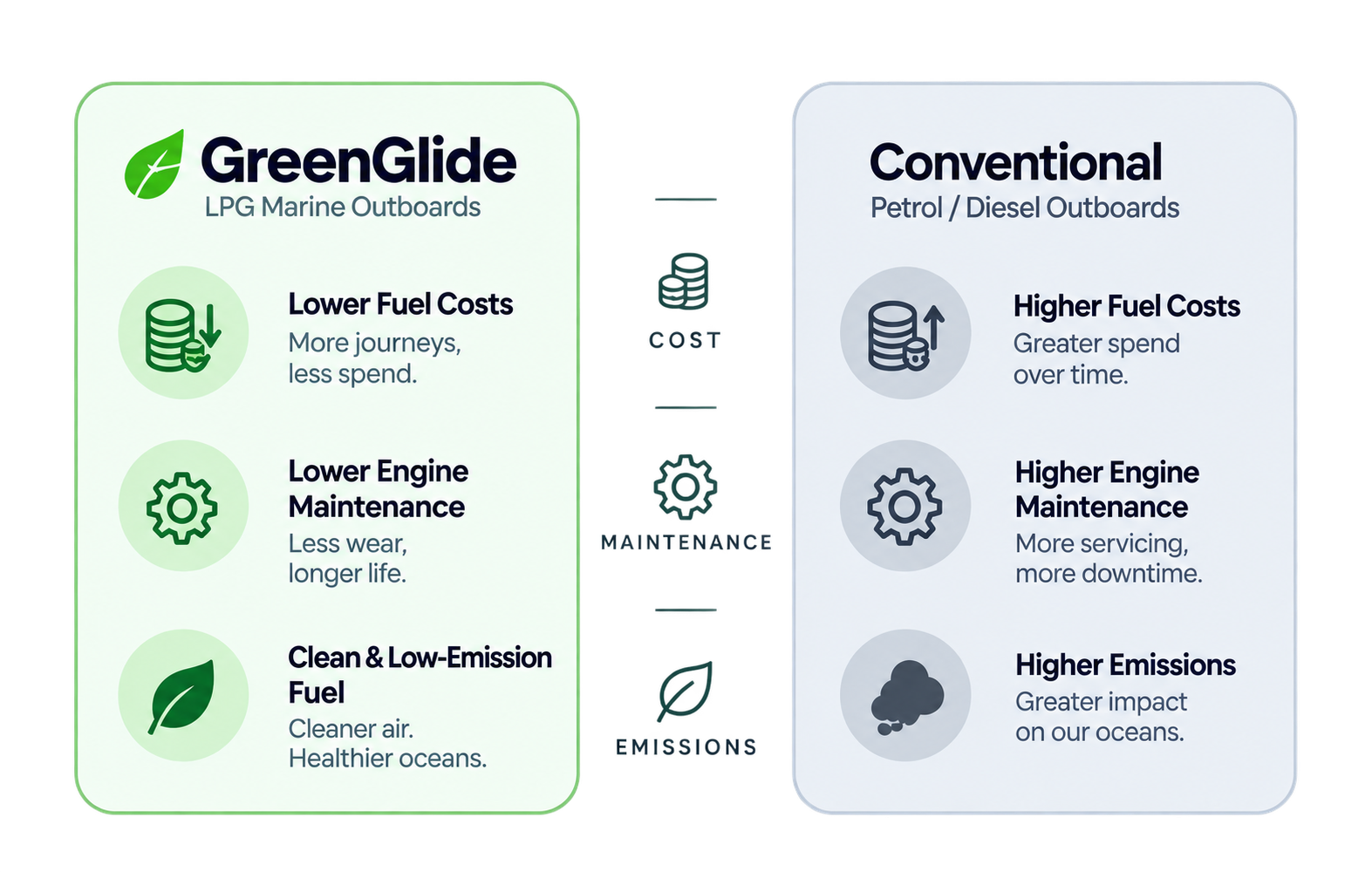
Lower Fuel Costs
Lower Engine Maintenance
Clean & Low-Emission Fuel
Reliable Fuel Availability
A SMARTER CHOICE FOR CLEANER SEAS
LPG vs Conventional Marine Fuels
Same Performance. A Cleaner, More Economical Tomorrow.
The Economics
Lower Running Costs.
Faster Payback.
LPG helps you do more on the water, with significantly lower running costs than conventional marine fuels. The initial investment can be recovered quickly through fuel savings, making it a smart long-term choice for boat owners and operators.
Lower
Fuel Costs
More jouneys,
less spend.
Lower Engine Maintenance
Less wear,
longer life.
Quick
Payback
Recover incremental costs in a short time, depending on usage.
LPG is a clean, high octane, abundant and eco-friendly fuel. Almost two-thirds of LPG is sourced from Natural Gas and the rest from refineries.
According to the UN International Panel on Climate Change (IPCC), LPG is not a greenhouse gas, meaning it is assigned a global warming potential (GWP) factor of zero.
The GWP factor of CO2 is 1 while that of methane is 25. In comparison to most hydrocarbons, LPG has a low carbon to hydrogen ratio replica horloges, which means that it generates lower amounts of carbon dioxide per amount of heat produced.
LPG is a gas at atmospheric pressure and normal temperatures, but it can be liquefied when moderate pressure is applied or when the temperature is sufficiently reduced. This property makes the fuel an ideal energy source for a wide range of applications, as it can be easily condensed, packaged, stored, and utilized. When the pressure is released, the liquid makes up about 250 times its volume as gas, so large amounts of energy can be stored and transported compactly.
Closer home, in India, LPG’s coverage is almost universal, with its availability reaching almost 100% in the last few years.
LPG is up to 5 times more efficient than traditional fuels, resulting in less energy waste and a better use of our planet’s resources. The same LPG cylinder can be used with many different appliances. Simply disconnect the hose from a product and reattach it to another product. The same LPG container for many applications
LPG is an environmentally friendly fuel with reduced pollutant emissions.
Harmful particulate emissions are absent. Compared to gasoline engines, CO & CO2 emissions are reduced by more than 50%, and other pollutants such as HC-NOx are reduced by up to 35%.
THE ETHANOL CHALLENGE
The Ethanol
Challenge
Petrol Marine Outboards, which were used until now, were not designed to address the significant change in the Indian petrol mix, which is already mandated to be with 20% ethanol blend.
Ethanol delivers significantly lower energy per unit and reduces engine efficiency. It also creates several issues for smaller marine engines, including absorbing moisture, generating corrosion and impacting vital components – this significantly increases the maintenance costs of the engine.
LPG addresses all these issues and, in fact, being a very low carbon fuel, ensures that the maintenance of the engine is even lower than that of petrol engines, thus resulting in a significant saving to the fishermen.
Absorbs
Moisture
Can lead to water related issues in marine engines.
Causes
Corrosion
Can impact vital engine components over time.
Lower Engine Efficiency
Delivers lower energy per unit, increasing maintenance costs.